
Leica Binoculars: Essential Accessories for Leica Photographers?
Only if you’re into nature, wildlife, travel, & maybe sports photography!
By Jason Schneider
Binoculars are optical observation devices that (with rare exceptions like the Cambinox and Ricoh Teleca, both camera/binocular combos) have nothing directly to do with taking pictures per se. However, binoculars can be very useful devices for locating and identifying potential subjects, which is why many experts consider them essential accessories for nature and wildlife photography. And as any experienced traveler knows, using binoculars can be a very efficient way of minimizing your footsteps, allowing you to scout a location from a distance to select areas, places, and structures of particular interest. Many sports shooters likewise use binoculars to find the ideal places for covering the action, or specific areas where interaction among competitors is most likely to occur.
Leica enthusiasts looking for a good pair of new binoculars will naturally gravitate to the extensive range of current Leica binoculars, which are among the best in the world, and usually carry prices commensurate with their topnotch quality and performance. User/collectors of vintage Leicas are more likely to peruse the online auction sites in search of classic Leitz-branded binoculars of the ‘20s through the ‘60s, which combine vintage panache with satisfying performance, and are frequently offered at enticing prices.


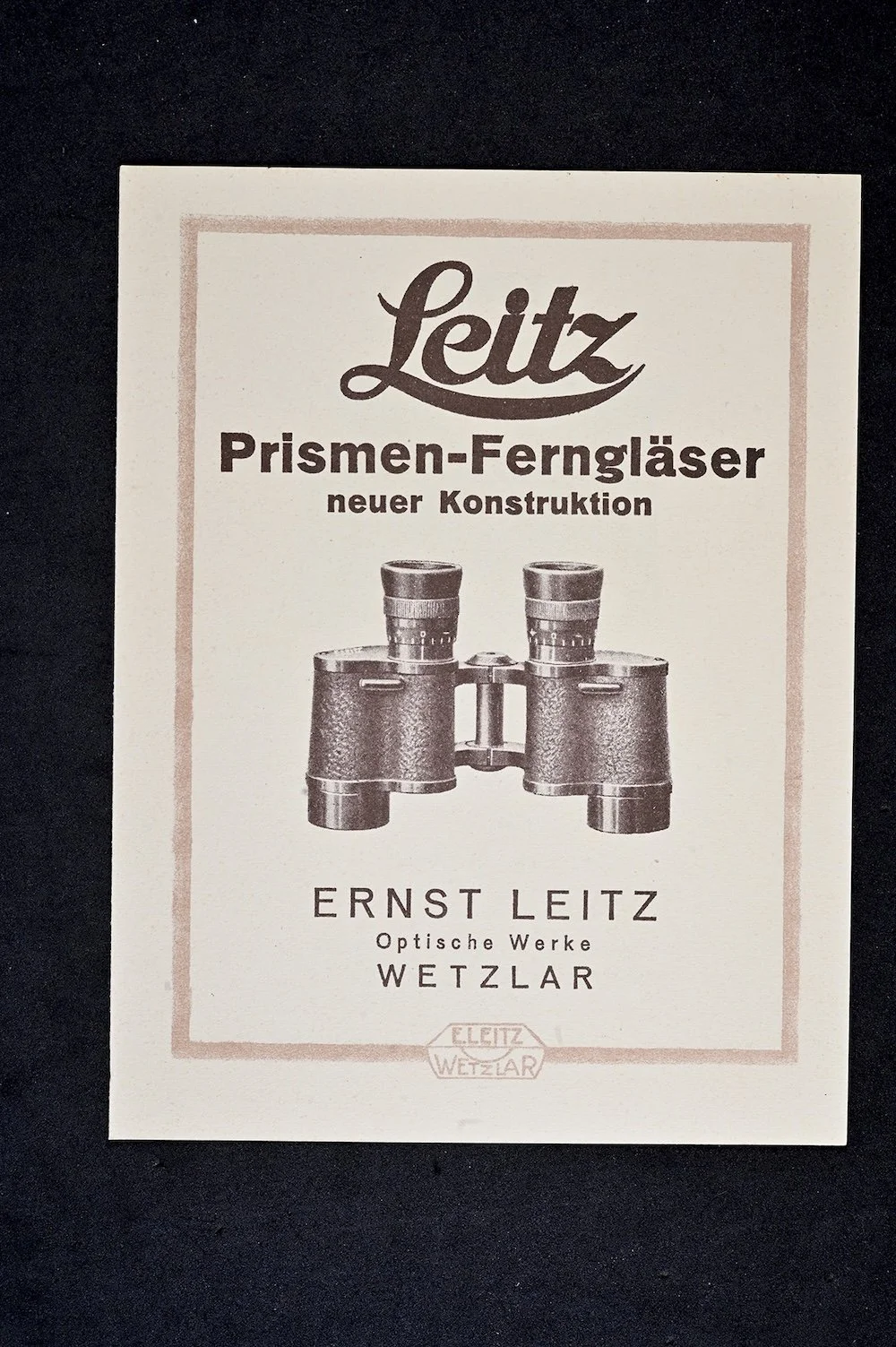


Leitz/Leica Binoculars: A 120-year-old Tradition!
The Leitz Binocle 6x18 of 1907, introduced 18 years before the first Leica camera, was the first commercial binocular produced by the Optische Werke Ernst Leitz in Wetzlar Germany, laying the foundation for modern Leica sport optics. Released on 14 May 1907 after 3 years of development, it is a rare and collectible piece that launched a new era for the company.
Designation: 6 x 18 (6x magnification, 18mm front objective diameter)
Features: Utilizes a Porro-prism system, often featuring an open bridge, curved upper housing covers, and finely cross-knurled eyepieces.
Specifications: Compact, typically measuring around 10 cm wide, 11 cm high, and weighing around 380 g, designed for portability.
Markings: Often engraved with "Binocle 6x" and "D.R.P." (Deutsches Reichspatent).
Status: Highly rare collectors' item that represents the foundation of Leica's modern sport optics division
Key Historical Milestones of Leitz/Leica binoculars
1907: Ernst Leitz II launched the company's first binoculars, the Binocle 6x18, marking their entry into civilian and military sport optics.
1917–1931: Leitz produced large quantities of 7 x 50 and 10 x 50 brass Porro II binoculars for the German military, becoming a major player in military optics.
1956–1958: The Amplivid wide-angle model appeared in 1956, followed by the first Trinovid models in 1958, known for superior image quality.
1960s-1970s: The Trinovid 2nd Generation introduced rubber armoring, with many, such as the 10x40, becoming legendary for durability, even being used by NASA in 1969.
1970s: Final production, calibration, and checking shifted to Portugal.
1986–1990: The company officially rebranded binoculars as Leica, and the Trinovid BA/BN models with superior eye relief and coatings defined the brand's reputation for high-end, waterproof, and durable binoculars.
1992: Leica introduced the Geovid, the first high-performance binocular with an integrated laser rangefinder, bridging the gap between observation and targeting.
Key Innovations & Designs
Leitz Trinovid: Famous for using internal focusing mechanisms, providing high light transmission, and compact designs.
Leitz Amplivid: Renowned for an extremely wide field of view (212 meters at 1000 meters).
Geovid Technology: The evolution of binoculars from simple observation tools to digital devices with ballistics, networking, and precision range-finding.
Legacy & Branding
While the camera company became Leica in 1986, many vintage models still proudly bore the "Leitz Wetzlar" brand, which was used until around 1990. Today, the company, with its headquarters in Wetzlar (Leitz-Park), Leica currently produces high-end binoculars in both Germany and Portugal.
New Leica Binoculars for Leica Photographers: Two Stellar Recommendations!
The extensive Leica binocular line currently features more than 20 models across several premium series (e.g. Noctivid, Ultravid HD-Plus and Trinovid HD, Geovid Pro) plus several compact, travel friendly options) ranging in price from about $500 to $4,000. Of these we’ve picked two that we believe offer excellent value, fine performance, and impressive versatility, but we strongly urge you to check out the entire line to see which ones fit your specific needs and pocketbook.
Leica 10 x 25 Trinovid BCA Binoculars $599.00
Inspired by their iconic full-sized counterpart, Leica 10x25 Trinovid BCA Binoculars deliver impressive performance in a highly portable and easy-to-carry design. They’re designed with a combination of phase-corrected BAK4 roof prisms, the proprietary HighLux system, and HDC fully multi-coated optics to produce bright and clear color-neutral images, while fitting comfortably in the hand for long, fatigue-free observation. The HDC coatings add abrasion-resistance to protect the exterior lens surfaces, and the lenses are also treated with AquaDura coatings, which makes it easy to clean off dirt, grime, oils, sap, and fingerprints without leaving residues that can interfere with views.
Designed to easily fit in a pocket, pack, or purse, the binoculars are made with a dual-hinge system that allows the optical tubes to fold and tuck under the closed bridge to ensure the smallest form factor when fully closed. This also provides a wide interpupillary distance adjustment for easier use by those with narrow faces—like children and adolescents. Helping to reduce the weight to a mere 9 ounces is an aluminum alloy chassis that is wrapped in a protective slip-resistant armor for a more comfortable feel in the hand. Light, compact, and easy-to-use while delivering bright and clear images, the Trinovid BCA binoculars are made to be your valued companion on the trail, at the stadium, or sightseeing around the world.
Optical Performance
Powerful 10x magnification allows for detailed observations of distant subjects
Compact 25mm objective lenses ensure slim optical tubes to maintain a compact form
BAK4 roof prisms deliver a round exit pupil, and a crisp and clear image with limited edge distortion
P40 phase-correcting prism coatings increase light transmission while improving contrast and clarity
HDC fully multi-coated system has abrasion-resistant and anti-reflection properties to protect exterior lens surfaces, and improve light transmission and contrast
HighLux-System (HLS) maximizes light throughput to improve color rendition and contrast
Hydrophobic AquaDura coating on external optical surfaces allows dirt, dust, and fingerprints to be removed easily
Use and Handling
Closed-bridge/dual-hinge configuration provides a sturdy platform for the internal focusing mechanism
Textured low-profile center focusing wheel helps to maintain an overall compact form
Wide 32-74mm interpupillary distance range accommodates use by a wide variety of users — especially those with narrow faces like children and adolescents
±3.5 right-eye dioptric correction allows user to compensate for optical prescription
Twist-up rubber eyecups for comfortable use with or without eyewear
14.6mm eye relief
2.5mm exit pupil
Construction Details
Dual-hinge design allows optical tubes to fold under the bridge for an ultra-compact form factor when closed to take up less space in packs and pockets
Lightweight and durable aluminum alloy chassis
Protective rubber armor provides a slip-resistant grip
Raised grip details enhance grip strength and security
Water-resistant to splashing water or rain
Compact 4.3x3.6" form factor is easy to pack and carry
Light 9-ounce weight
Leca 8 x 42 Geovid R Rangefinder Binoculars $1,579.99
Leica 8x42 Geovid R Rangefinder Binoculars combine powerful binocular optics with a precise rangefinder in an extremely compact, lightweight package. The Geovid R delivers a field of view that is outstanding in its class, as well as great image detail and exquisite color accuracy. With an improved measurement range of up to 2000 yards, you are perfectly equipped for almost any observation and measurement in nature and wildlife applications. When used in shooting/ hunting applications the ballistics function EHR, which outputs the equivalent horizontal distance for angle shots at up to 1200 yards, additionally facilitates ethical shooting.
Precise laser range-finding
Up to 2000-yard measurement range
Up-to-date, ergonomic design
Lightweight, compact form factor
Key Specs
Magnification | 8x
Objective Lens Diameter | 42 mm
Power Source | 1x CR2
Laser Type | Class 1 Eye Safe
Metering Range | 2000 yd / 1828.8 m
Accuracy | 400 yd / 365.8 m: ±1 yd / 0.9 m; 800 yd / 731.5 m: ±2 yd / 1.8 m
Prism Type | Roof
Objective Lens Diameter | 42 mm
Angle of View | 7.2° (Actual)
Field of View | 375' @ 1000 yd / 124.5 m @ 1000 m
Minimum Focus Distance | 18.4' / 5.6 m
Exit Pupil Diameter | 5.25 mm
Eye Relief | 15.5 mm
Dioptric Correction | ±4
Display Type | LED
Inclinometer | Yes
Environmental Resistance | Water-Resistant (Unrated); Fog-proof
Nitrogen Filled
Dimensions | 6.8 x 4.9 x 2.8" / 17.3 x 12.4 x 7.1 cm
Weight | 33.9 oz / 961.1 g
Vintage Leitz Binoculars: An Online Selection at Enticing Prices:
Leitz Wetzlar prewar 6 x L25 (6 x 25) binoculars, black with leather case, $175.00 or best offer plus $7.26 shipping, no returns.
Leitz Wetzlar 7 x 35B Trinovid 150m/1000m binoculars made in Germany, tested and works well, with case, $199.99 Buy it Now, with case, 30-day returns.
1937-1939 Pre/Early WWII E. Leitz Wetzlar Marsept 7 x 50 Binoculars, fully functioning with leather strap, $124.99 free shipping, 30-day returns.
Leitz Trinovid 10 x 40BA binoculars, very good condition except for one broken strap loop, olive color $390.00 Buy it Now, no returns,
Note: Binoculars, which are often used outdoors in inclement conditions, are more prone to developing fog and haze than, say, camera lenses of the same vintage. Therefore, it is important to make sure any used binoculars you buy are clear and free of these defects before you consummate the sale. Better yet, buy from sellers who offer no questions asked return privileges and then inspect the glass carefully as soon as you receive it.
Special thanks to James Lager for providing all the images for this article except as noted.