
High- and Low-production Leica Lenses: Timeless Vintage Classics!
They’re not cheap, but all capture great images with matchless charm.
By Jason Schneider
Leitz (now Leica Camera AG) has now been making outstanding camera lenses for 112 years, if you count the 6-element, non-interchangeable 42mm f/4.5 Mikro-Summar photo-microscopy lens Oakar Barnack pressed into service on his UR-Leica of c.1913. Leitz didn’t get into making interchangeable camera lenses until they released the Leica I (Model C) in 1930, the first screw-mount Leica, that was made in both non-standardized and standardized (LTM) versions. The latter was compatible with the 3 earliest Leica screw-mount lenses, the 3.5 cm f/3.5 Elmar, the 5 cm f/3.5 Elmar, and the 13.5 cm f/4.5 Elmar. Since those early days Leica has turned out a staggering variety of interchangeable lenses in screw mount (LTM), M-mount, L-mount, S-mount, and various configurations of the R (Leica R/Leicaflex) mount. Obviously, we can only cover a tiny fraction of them here, but here’s a brief overview of two broad categories, high-production Leica lenses and low-production Leica lenses, to give you a better idea of what’s out there and possibly worth shooting with or adding to your collection.
High-production Leica Lenses: A Treasure Trove for User-Collectors
As anyone who’s shot with a 50mm f/3.5 Elmar can attest, this iconic lens, introduced in 1926, can capture sharp, detailed images with a charming vintage look. Later coated versions deliver somewhat higher contrast and are less prone to flare, but all can deliver outstanding imaging performance across the field at apertures of f/5.6 on down. The total number of 50mm f/3.5 Elmar lenses Leitz turned out in screw mount (LTM) and M-mount from 1926 to 1961 (all configurations) is estimated by most experts to be about 360,000, making it one of the highest production Leica lenses ever. Average used price (all versions): $200 to $400. Late “red scale” models run somewhat higher.
According to Leica-Wiki, other high-production Leica lenses include the 50mm f/2 Summar of 1933 to 1940 with a total production of 127,950 (120,000 of which were collapsible), and the 50mm f/2 Summitar of 1939 to 1955, (coated beginning in 1946), with a total production of 172,390. The 50mm f/2 Summicron, which was introduced in M-mount in 1953, is currently available as the 50mm f/2 Leica Summicron-M ($3,205), the 50mm f/2 Leica Summicron-SL ASPH. in L-mount ($2,350), the 50mm f/2 Leica APO Summicron-M ASPH. ($9,945 in black, $10,265 in silver anodized finish) and the 50mm f/2 APO-Summicron-SL ASPH in L-mount at $5,450. There is no precise, universally accepted figure for the total production of all variations of the 50mm f/2 Summicron lens from 1953 to 2025, but it surely runs into the hundreds of thousands.
It's clear from the above that Max Berek, longtime chief camera lens designer at Leitz, got it right the first time when he designed the 50mm f/3.5 Elmar, which was coated and tweaked over its lifetime, but never fundamentally redesigned. However, developing the 50mm f/2 took two major steps—upgrading the classic 6-element, 4-group double Gauss Summar to the 7-element, 4-group Summitar, which delivered much greater sharpness across the field at the widest apertures, and then recalculating the optical formula to create the 7-element, 6-group Summicron design that yielded even greater sharpness over the entire aperture and distance ranges. All these high-production Leica lenses are outstanding user-collectibles that are currently offered at enticing prices. A standard 50mm f/2 collapsible Summar currently runs about $250 to $400 used depending on condition; a 50mm f/2 Summitar in clean condition will set you back around $400 to $500; and a clean, early rigid or collapsible 50mm f/2 Summicron in screw or M-mount generally runs $500 to $1,500 depending on the specifics. However, if its real optical “character” you’re looking for you can’t beat the following quintet of low-production vintage classics:
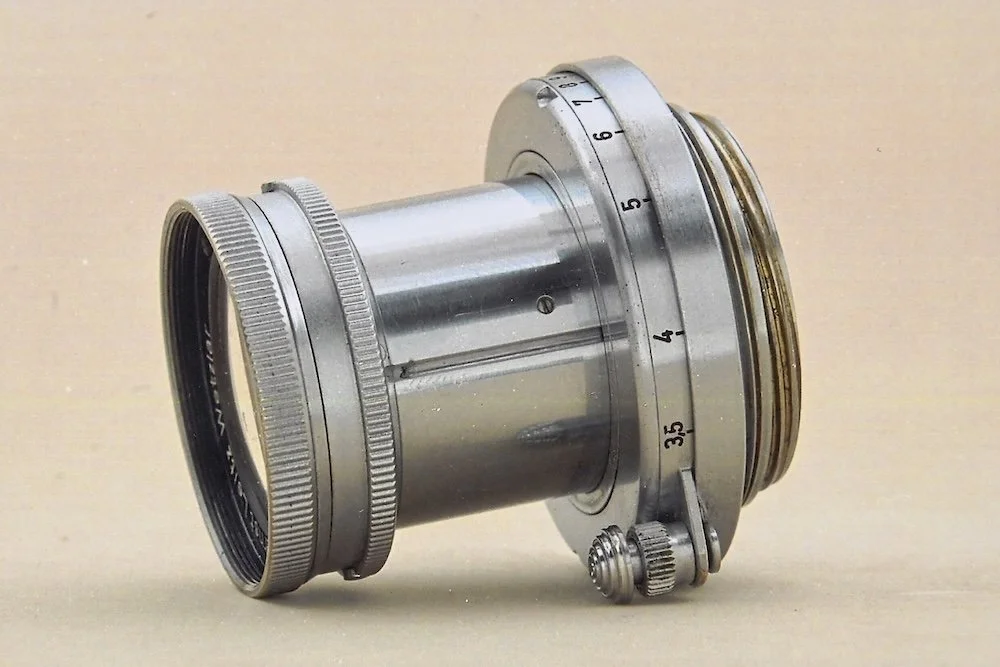
Side view of the rare 7-element 5cm f/2 Tropen Summar. Note lens-locking groove on barrel.
Low-production Vintage Leica Lenses: Four User-Collectible Classics
Note: For the purposes of this article a “low-production Leica lens” is defined as one that was made in sufficient quantities to be generally available to enthusiasts. This excludes rare lenses made in quantities fewer than 100 or where only a handful of examples are known to exist.
10.5 cm f/6.3 Elmar, known as the “Alpine Elmar” or “Mountain Elmar”
Produced in black (to 1933), black and nickel, and black and chrome finish, in metric and footage versions, this compact, beautifully made, reasonably light weight (208g), uncoated 4-element, 3-group Tessar-type was in production from 1932 to 1937 and according to Leica-Wiki, only 3,975 units were produced in total. However, this conflicts with the “Total Assigned Serial Numbers” figure of 4,606+ covering the period 1930 to 1936. In either case the “Alpine Elmar” qualifies as a low production lens and a collector’s prize. It’s also a fine picture taker according to user reviews, delivering “surprisingly sharp images when stopped down,” especially in the center, and a pleasantly “atmospheric” rather than “clinically sharp” rendition across the frame. Drawbacks: tendency to flare when shooting against the light (lens hood strongly recommended), its long minimum focus distance of 2 meters, which limits its versatility, and its small maximum aperture that inhibits its use in low light. Nevertheless, the 105 Elmar is well suited to such niches as landscape and street photography. Current price range in clean, working condition: $600 to $1,000.
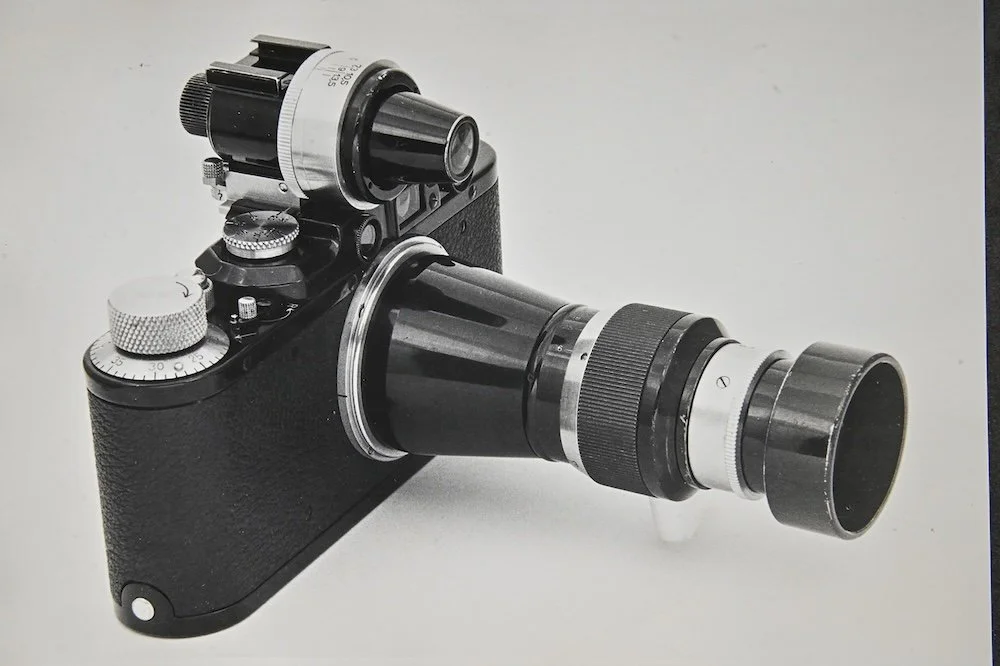
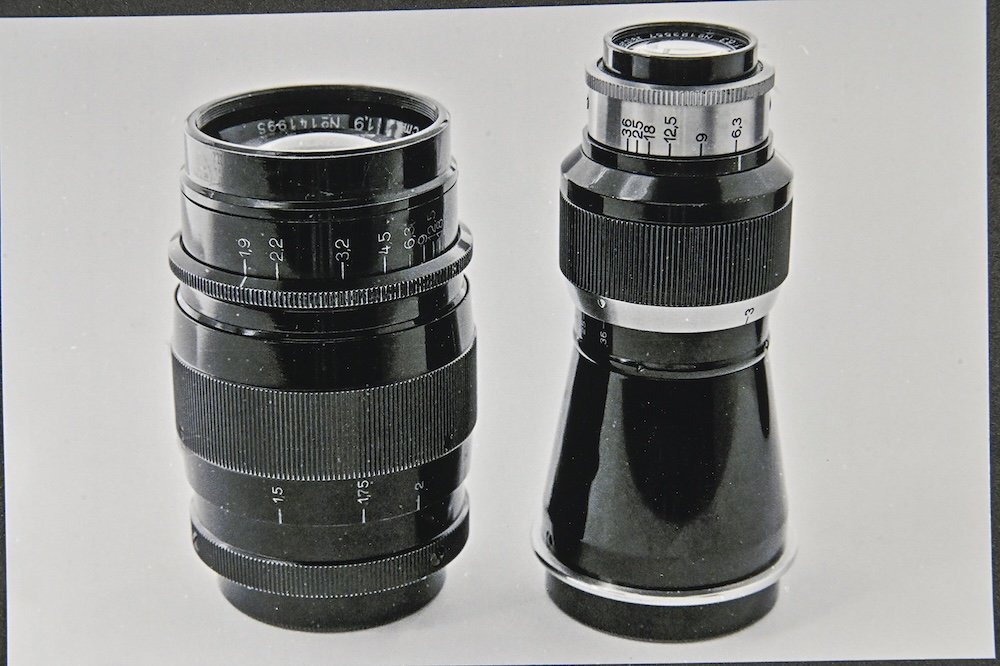
7.3 cm f/1.9 Hektor Fast Moderate (portrait) Telephoto
This fast portrait tele is a signature Max Berek 6-element, 3-group design that lands at the short end of the medium tele range. Leitz made a total of 7,225 of these chunky 460 g (1.1 pound) uncoated beauties between 1930 and 1941, and all had 12-bladed diaphragms that stop down to f/36, and a minimum focus distance of 1.5m, close enough for a nice head-and-shoulders portrait. The 7.3 cm Hektor was made in all black, black with nickel band, black with chrome band, and wide chrome band versions, all measuring 80mm long and 53mm in diameter. Performance-wise, the lens is quite soft at f/1.9, but improves considerably when stopped down, becoming reasonably sharp by f/6.3. As a general-purpose lens, it can be challenging (and may require a shoe-mount 7.3cm optical finder such as the SAIOO if your Leica’s viewfinder doesn’t have a 75mm frame line) but it excels as a portrait lens thanks to its softness, shallow depth of field, and gorgeous vintage rendition. This screw-mount classic is widely available on the used market but pricey at $850 to $2,000 in clean working condition.

7.3 cm f/1.9 Hektor Leica Wiki page shows 6-element, 3 group design in partial cross section
8.5cm f/1.5 Summarex High Speed Medium Telephoto
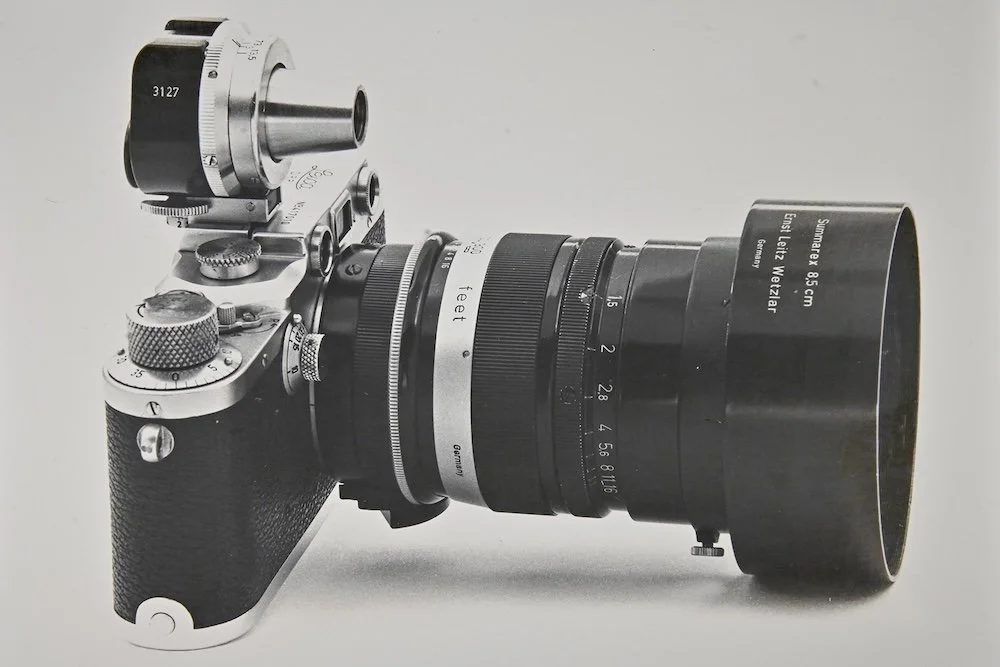
Perhaps the most technically successful of Max Berek’s telephoto designs, the 8.5cm f/1.5 Summarex (named after his dog “Rex”) is a coated 7-element, 5-group double Gauss design with a 17-bladed (!) diaphragm that stops down to f/16. The lens focuses down to 1 meter, close enough for frame-filling head shots. In production from 1943 to 1954, total production came to 5,006 units according to Leica Wiki, mostly in chrome finish with fewer than 300 units in black. It was made in both screw mount (LTM) and M-mount, the latter being far rarer, and it weighs in at a hefty 800g (1.75 pounds).
The 8.5cm f/1.5 Summarex is surprisingly sharp even wide open, though it has lower contrast than modern equivalents due to its less sophisticated coatings. Users say it has a “dreamy” rendition that works well for portraits, as well as a “creamy” or “swirly” bokeh that varies depending upon the background. It is also a good choice for low light work or creating effects that rely on shallow depth of field, but focusing on moving subjects can be challenging. It’s a unique lens all right but you’d better have deep pockets. Current price range in clean working condition: $2,000 to $3,500 in chrome; around $10K in black! Note: while no Leica M viewfinder provides an 85mm frame line, the 90mm frame line is a good workaround, even though it shows slightly less than full area of the captured image.

90mm f/5 Elmar, 3-element Version (III)
The 90mm f/4 Elmar in screw mount (LTM) was one of the very first interchangeable lenses offered for the Leica, and over 79,600 were made in coated and uncoated versions from 1933 to 1968. It was replaced by the 90mm f/4 Elmar-C (1973 to 1977) with a production total of 48,600. Then came the 90mm f/4 Elmar (III), a far less common, modern 3-element, 3-group version of the venerable 4-element Tessar-type 90mm Elmar that was (astonishingly) noticeably superior in every way to the older design! And since only 9,400 of the 3-element 90mm Elmar were ever made, it now qualifies as a coveted classic that’s fetching fancy prices.