
Leitz Patents: Protecting the Innovations that Defined the Leica Legend
Records that trace the Leica’s remarkable history with utmost precision!
By Jason Schneider
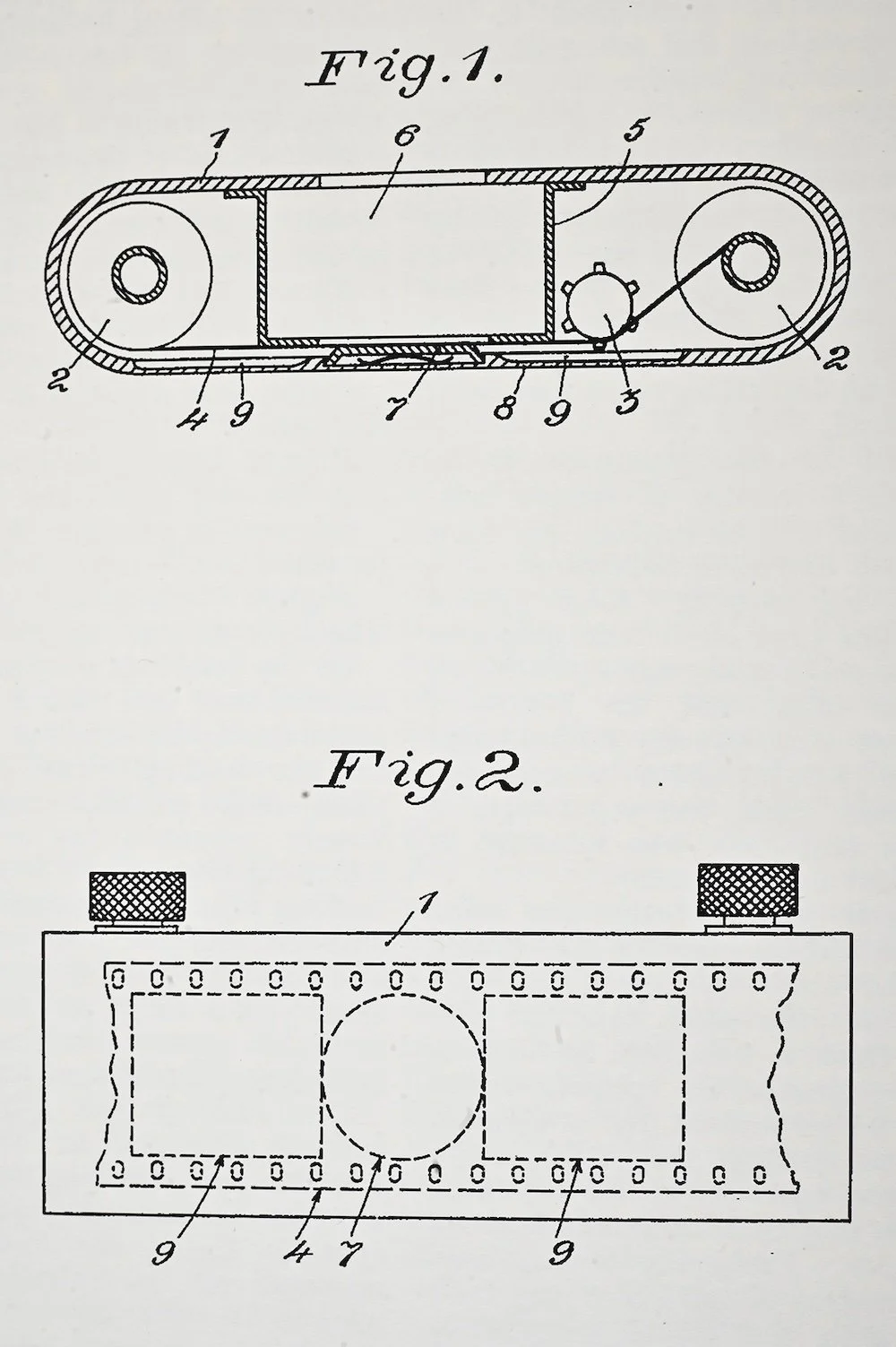
Looking back over the past century of Leica, it’s hard to believe that many of the defining features of the earliest Leica cameras were so revolutionary and innovative at the time that they were granted patents under the Deutsches Reich Patent (DRP) system. One seminal patent DRP Nr. 384071, applied for on 2 July 2022 and granted to Ernst Leitz, Optische Werke in Wetzlar on 3 November 1923 was for a “Rollfilmkamera.” Not a roll-film camera in today’s parlance, it used double perforated 35mm cine film that moved horizontally through the camera and provided a 24 x 36mm format, with spacing controlled by a sprocket wheel that stopped in the right place as the film was wound to the next frame. This system has been used in some form on virtually every one of the millions of 35mm film cameras ever made, including of course, Leicas.



Other significant early Leitz DRP patents include one for the self-capping, dual-curtain, horizontal focal plane shutter made of rubberized cloth, the 39mm Leica screw mount with a thread pitch of 26 threads per inch (about 0.977mm) and a flange focal distance if 28.8mm, the spring-loaded rangefinder coupling arm terminating in a roller that was introduced with the Leica II (Model D) in March 1932, and the ingenious slow speed escapement with front-mounted slow speed dial first fitted to the Leica III (Model F) in 1933.
Lest you think that the Leica M3 emerged fully formed from the head of Leitz in 1954, the patent history proves that its exquisite range/viewfinder with multiple auto-indexing, parallax-compensating projected frame lines was really the culmination of a long process of development dating back to the mid 1930s. The brilliant 4-lobe M bayonet mount came somewhat later, designed by mechanical genius Hugo Wehrenpfennig of Leitz, and officially patented on 23 October 1952. To present a clearer, more comprehensive overview of the unique and unparalleled history of Leica’s vintage era as told through its patents, here are some of the salient details:
German Patent No. 384071, historically known as Deutsches Reichspatent (D.R.P.) No. 384071, is one of the most foundational milestones in the history of photography. It officially protected the innovative mechanics that enabled the creation of the 35mm still picture camera.
Core Innovation: The modern 24 x 36mm Format
Before this invention, 35mm film was, with rare exceptions, exclusively used for motion pictures (cinema). Cinema cameras ran the film vertically, producing a standard frame size of 18 x 24mm. Oskar Barnack, a brilliant development engineer at Leitz, realized he could use this highly accessible cinema film for a compact still camera. And he understood that doubling the size of the frame would yield better image quality. His breakthroughs protected by this patent included:
Horizontal Film Transport: Instead of pulling film vertically (as in a cine camera), the mechanism transported the film horizontally. Doubling the Frame Size: By pulling the film horizontally, Barnack was able to double the cinema frame size to 24 x 36mm, establishing a 2:3 aspect ratio. These exact dimensions later became universally known as "full frame" 35mm format. Note: There was another, obscure, limited production still picture camera, the American made Simplex of 1914, that offered a 24 x 36mm format option prior to the Leica, but it was unknown to Barnack and enjoyed little commercial success even in the U.S. (one report says that fewer than 50 were produced).
A Legacy Inscribed on Early Leica Cameras
Note: many vintage, pre-1945 screw-mount Leica cameras (such as the Leica I, II, and III) are engraved "D.R.P." on the top plate. This abbreviation directly references the 1923 Reichspatent, serving as a proud badge of the proprietary mechanical framework that established modern 35mm still photography.
Leitz slow speed shutter mechanism on Leica III
The Leitz slow-speed shutter mechanism was introduced with the Leica III (Model F) in 1933, expanding the capabilities of the original Barnack focal-plane shutter design to provide exposures at timed speeds from 1 sec to 1/20 sec.
History & Designers
The mechanism—historically referred to in factory records as the Hemmwerk (escapement mechanism)—was designed by Leica’s legendary creator Oskar Barnack alongside engineer Wilhelm Albert. According to historical Leitz construction logs, the official development date for the Leica slow-speed mechanism is given as January 17, 1933.
How the Mechanism Works
The Leica III split the exposure controls into two separate dials. The top dial controls the fast speeds (originally 1/20s to 1/500s). To use the slow shutter speeds, this main dial must first be turned and set to the "20-1" mark (or "30-1" / "25-1" on later iterations like the IIIc and IIIf). The slow speed dial, a separate, small round speed selector fitted directly to the front of the camera body next to the lens mount, acts as a clockwork mechanical brake.
Internal Mechanics
When the top dial is set to the slow-speed crossover position, it engages an internal swinging shaft inside the camera. When the shutter button is pressed, a flat spring on the bottom of the camera raises this shaft arm, forcing a tooth on the second curtain roller to engage with a miniature escapement gearbox located at the bottom of the lens area.
The front dial restricts or allows the gear train to turn freely, forcing the shutter mechanism to dissipate a precise amount of energy before allowing the second curtain to snap shut, completing the exposure. Because these early clockwork calibrations rely on friction and spring tension alone, they are often the first component to stick or lag if the original lubricants dry out.
The landmark Leica M3 range/viewfinder
The development of the groundbreaking Leica M3 messucher (measuring bright-line range/viewfinder) was covered by a sequence of key patents filed by Ernst Leitz GmbH, stretching from early pre-war concepts to the final integrated mechanism finalized just before the camera's 1954 release. The exact patent numbers and filing dates that built the M3 viewfinder system span multiple eras as follows:
Foundational Pre-War Patents
These early patents laid the groundwork for projecting bright lines and merging the rangefinder and viewfinder windows into a single eyepiece.
German Patent (D.R.P.) No. 48425
Filing / Registration Date: 1936
Details: Describes a unified system combining a rangefinder with a telescopic universal viewfinder featuring sharp image delineation. Crucially, it introduced the foundational concept of displaying different fields of view using an automatic indexing system as lenses are changed, alongside early provisions for parallax compensation
U.S. Patent No. 1,127,925 (and related 1935–1936 filings)
Filing Date: January 31, 1935
Details: Patented the early concept of an Albada-type concave reflecting viewfinder system that provided reflected frame lines in the finder using external light windows. This eventually evolved into the M3’s distinctive projected frame-line system that included a separate frosted frame-line-illumination window.
The Integrated Rangefinder-Viewfinder Patent
German Patent No. 1,941,561
Filing / Conception Year: 1941
Details: Covered the comprehensive realization of the combined "measuring bright-line viewfinder.” It describes the large single eyepiece showing a nearly life-sized subject magnification (~0.9x) with a central luminous rectangle functioning as a parallax-free coincident/split-image rangefinder patch.
The Final M3 Auto-Indexing-Frameline & Lens Mount Patent
This is universally held to be the most critical "master" patent that defined the functional mechanics of the commercially manufactured Leica M3 camera.
German Patent No. 935,884
Filing Date: 1952
Inventors: Ludwig Leitz and Hugo Wehrenfennig
Details: Titled "Photographic camera with interchangeable lenses and a rangefinder, particularly a rangefinder-viewfinder system with insertable frames corresponding to different focal lengths". This patent tied the newly designed M-bayonet mount to the internal viewfinder mechanism, allowing the camera to automatically actuate the correct 50mm, 90mm, or 135mm bright-line frames based on which lens was locked into place.
It should now be crystal clear that the remarkable evolution and success of the Leica rangefinder camera was the product of brilliant minds, uncommon ingenuity, and dogged determination. The patents tell the tale, and the proud Leica legacy lives on.
Heartfelt thanks to James Lager for providing all the illustrations accompanying this article.