
Three Top Leica M’s: The only pro-grade 35mm film cameras in production!
The Leica MP, M6, and M-A: A living testament the proud Leica legacy.
By Jason Schneider
Over the past five years film has made a comeback. And while it’s highly unlikely that film will ever regain its status as the dominant image capture medium, it has its charms, especially for Gen Z and younger photo enthusiasts, as well as some older folks. For many photographers it’s not just about nostalgia, but about the craft and intentionality of creating a photo. Shooting film encourages a slower, more deliberate approach because the results are not immediately viewable on an LCD and the maximum number of pictures you can shoot per roll is a lot more limited, typically maxing out at 36 frames. Film shooters say the inherent discipline of the medium gives them more control, imparts a feeling of responsibility for the resulting images, and produces a physical object you can hold in your hand rather than a digital file. Is the current upsurge in analog photography a transitory retro trend or a transformational event? Only time will tell, but Leica clearly has all bases covered!



Given the current fascination with film photography, which is reflected by (among other things) higher prices for vintage film cameras, it’s somewhat surprising that there are so few full frame (24 x36mm format) 35mm cameras in current production. Rollei offers the Rollei 35AF, a new autofocus iteration of the classic compact Rollei 35, with LIDAR (Light Detection and Ranging) AF down to 2.3 feet, apertures f/2.8 to f/16, shutter speeds from 1 to 1/500 sec, a noninterchangeable 35mm f/2.8 5-element glass lens, built-in auto-flash, and more, for $828.00 in black and $749.95 in chrome. Lomography markets the black only Lomo MC-A, a high-end point-and-shoot with a retractable 5-element 32mm f/2.8 multicoated glass lens, autofocus or zone focusing, autoexposure or full manual settings (apertures f/2.8 to f/16, shutter speeds 1-1/500 sec plus B) and built-in auto-flash at $549.00. And the Dutch, Amsterdam-based Analogue Agency sells the Analogue aF-1, a “premium modern 35mm point-and shoot” with a 6-element, 4-group Double Gauss 35mm f/2.8 lens that focuses down to 0.5m, shutter speeds of 4 to 1/1000 sec, LIDAR plus Time of Flight (ToF) autofocus, built-in auto-flash, and “splashproof” construction for 449.99 Euros (about $566). However, you must buy it directly from them. Finally, there’s the cute little Kodak-branded Snapic, a sleek low-end walkaround full frame 35 with a glass 3-element 25mm f/9.5 wide-angle lens, 2-zone manual focus, a single 1/100 sec shutter speed, and auto loading, auto advance and auto rewind. It’s yours in black or white for 99 bucks!
That’s about it, as far as new full frame 35s are concerned—the Russians used to make scads of 35mm cameras, but they’ve evidently gone all digital, at least in the full-frame 24 x 36mm-format arena.
So, when it comes to superlative, professional caliber, full frame 35mm cameras Leica has the field all to itself! The current Leica MP, M6, and M-A are all elite, fully mechanical film cameras with shared core mechanics but are aimed at users with different preferences. All incorporate the 6-frame viewfinder with frame lines covering focal lengths of 28mm, 35mm, 50mm, 75mm, 90mm, and 135mm, that debuted on the Leica M4-P of 1980, and all have Leica’s classic manual mechanical, horizontal-travel, rubberized cloth focal plane shutter with speeds of 1 to 1/1000 sec. plus B, a removeable base plate, a hinged back section, and fixed easy-loading take-up spool.
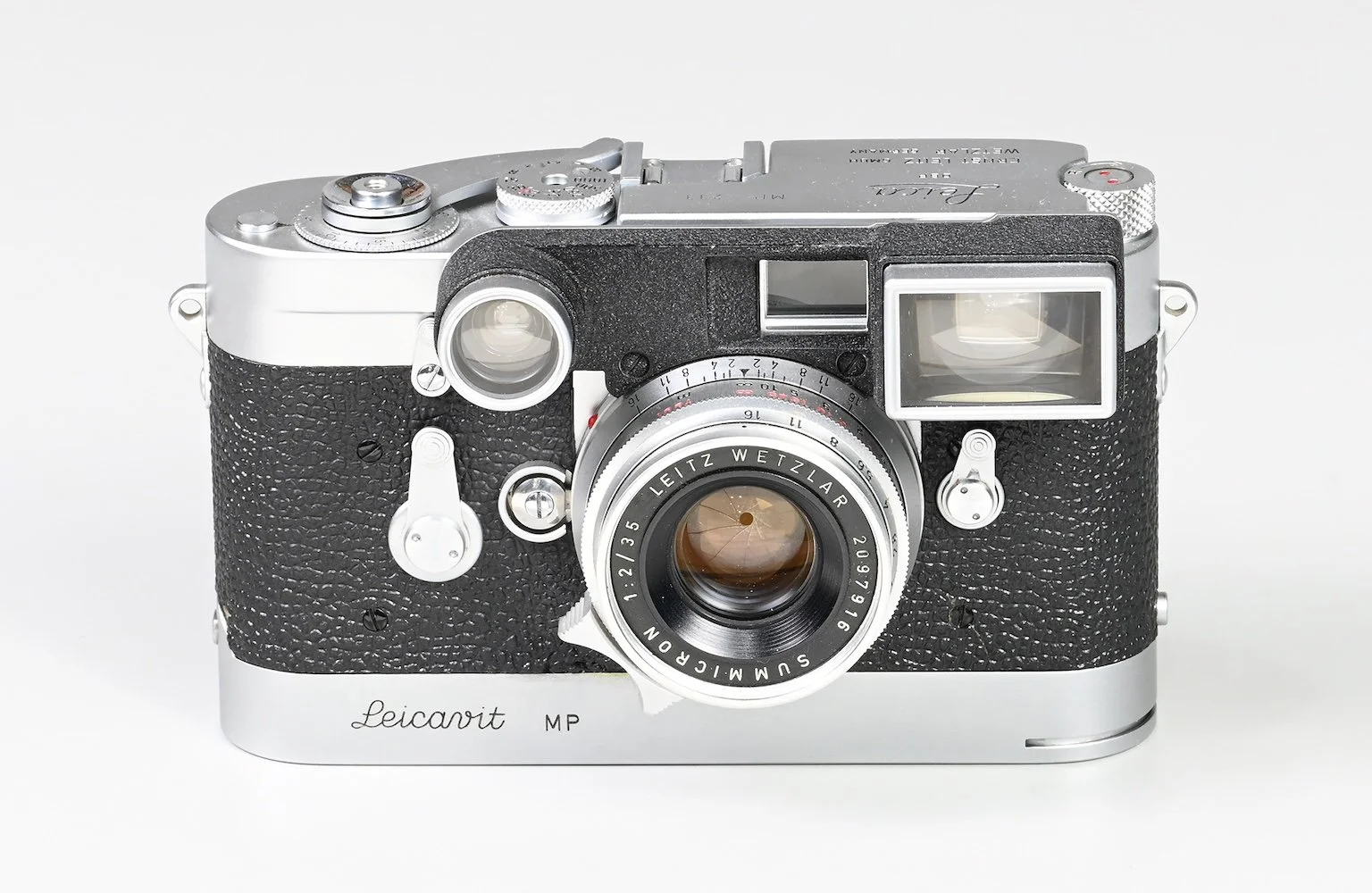
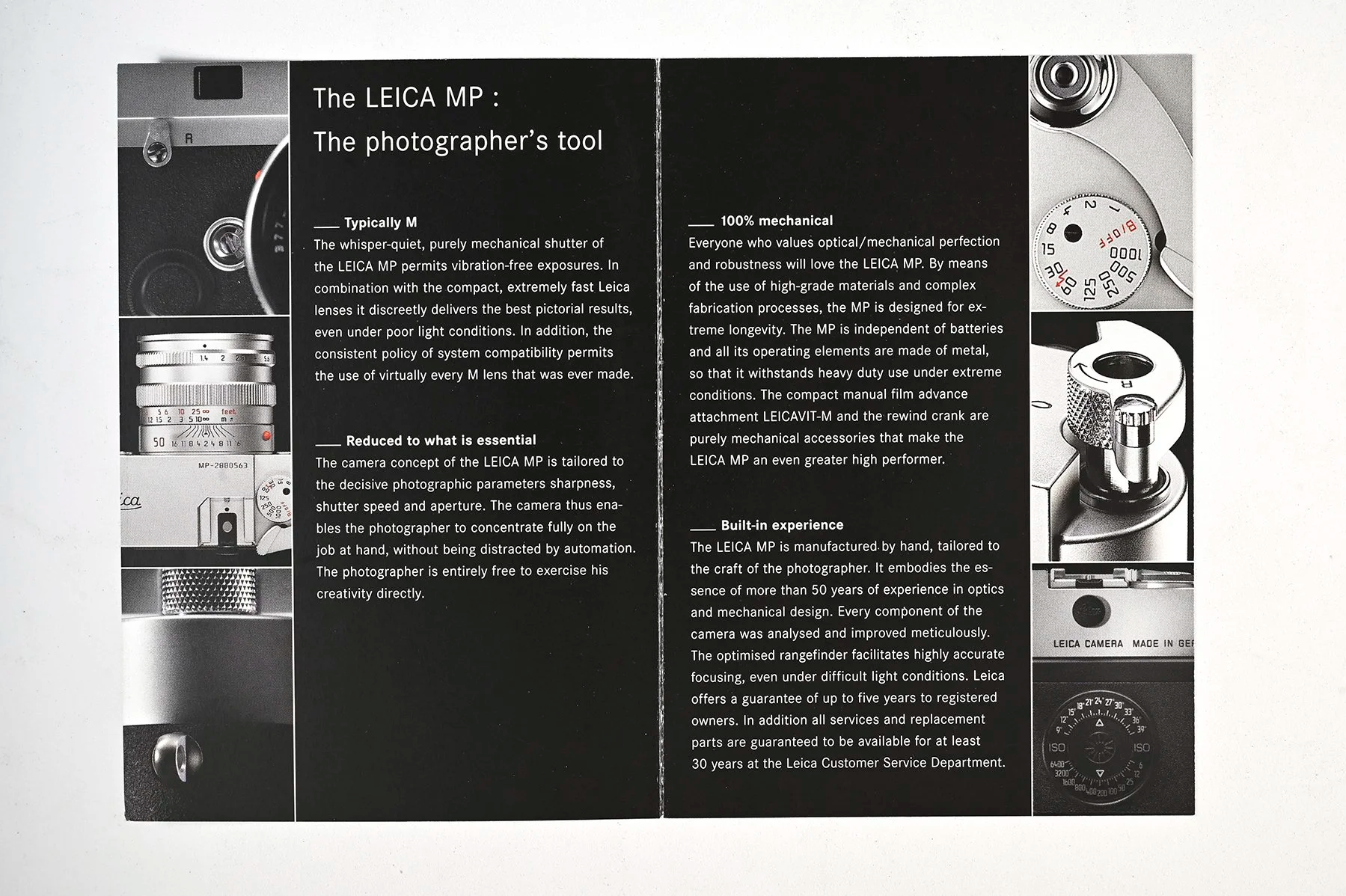
The Leica MP (which now stands for “Mechanical Perfection”) was introduced in 2003, adopting the iconic name of the coveted (and now stratospherically priced) limited edition original Leica MP of the mid-1950s that was created for credentialed press photographers. Available in glossy black paint (which typically brasses over time) or silver chrome finish, it features a 0.72x magnification range/viewfinder, built-in TTL metering with LED readouts, classic metal advance lever and accepts a Leicavit MP rapid winder. Current price, body only, $7,100.00 in black, $6,600.00 in silver.
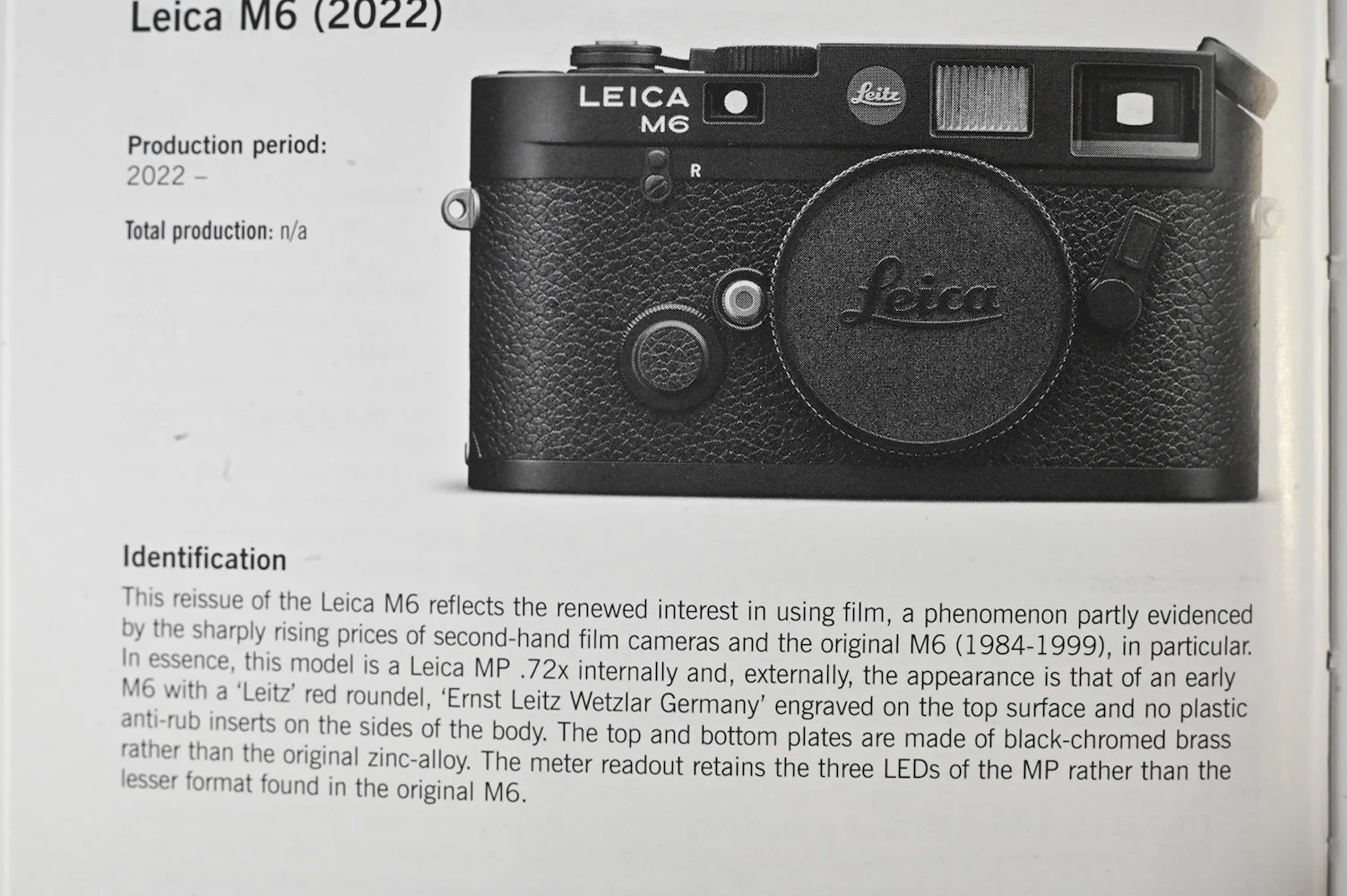
Leica M6 (2022 reissue): Finished in matte black chrome or silver chrome, it features a canted rewind lever, a plastic-tipped wind lever, and a solid brass top adorned with a Leitz Red Dot logo. The range/viewfinder was upgraded to match the high-quality flare-resistant finder of the current MP. The built-in TTL meter was re-engineered with modern electronics and sports an updated display with a central “proper exposure” dot in addition to LED arrows on either side. It accepts a Leicavit winder M. The M6 is a great daily shooter for those who want a new, dependable, metered Leica M and it still has plenty of “vintage” appeal. Current selling price, body only, $7,000.00 in black or silver finish.
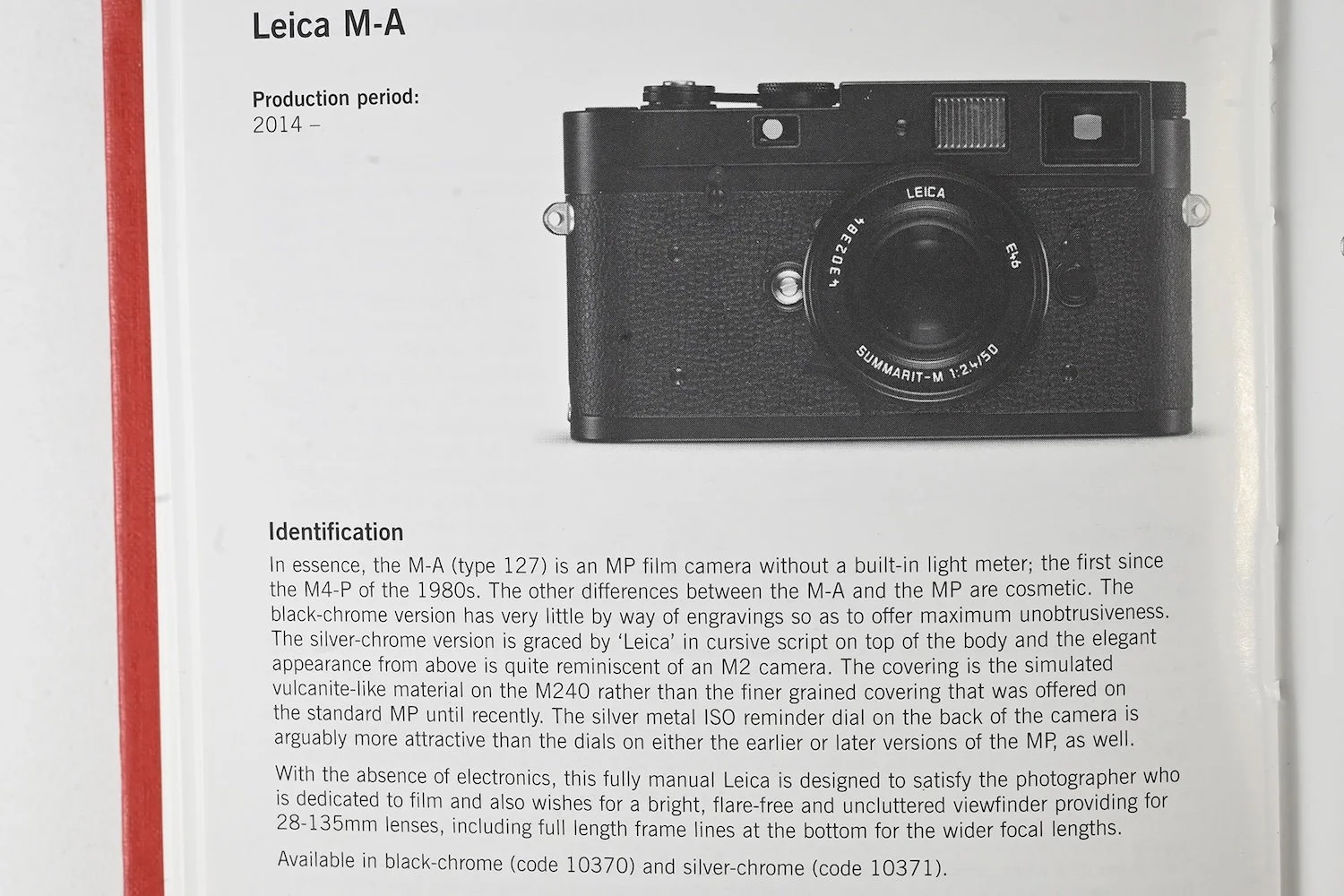
The Leica M-A (Type 127) debuted in 2014 and is the obvious choice for purists who want something akin to a modern Leica M3 or M4. It is a meter-less, totally mechanical machine devoid of electronic circuitry, and of course requiring no battery. A minimalist camera, it has no red dot, and it provides the cleanest view since there are no metering LEDs or readouts, so the field frame lines are unobstructed. There is an ISO reminder dial on the back, and the solid metal film-wind lever is classically contoured. This is the Leica M for diehard traditionalists, studio shooters and those who rely on separate handheld meters, or the sunny 16 rule. Current retail price for an M-A, body only: $7,000.00 in black or silver finish
Other film enthusiasts may bemoan the dearth of choices when it comes to acquiring a new full frame 35mm cameras, but for Leicaphiles, there’s an embarrassment of riches for those with the wherewithal to acquire it. Profuse thanks to Leica historian James Lager and to Todd Gustavson of the George Eastman Museum for providing the images for this article.